






The most used lasers are infrared, green and UV systems at the moment. A new type, blue laser started to attract some attention in 2017. Today, we want to introduce a leading technology from Laserline GmbH, a blue diode laser. What is a blue diode laser? How about the application potential? In the following text, Markus Ruetering, Asia sales manager of Laserline, will give us answers.
目前最常用到的激光是紅外、綠光和紫外激光係統。在2017年,一種新型藍色激光器逐漸開始吸引了人們(men) 注意力。今天,我們(men) 想要介紹一種來自Laserline公司的領先技術——藍光半導體(ti) 激光器。藍光半導體(ti) 激光器是什麽(me) ?其應用潛力如何?在下麵的文章內(nei) 容中,Laserline的亞(ya) 洲銷售經理Markus Ruetering將給我們(men) 做出解答。
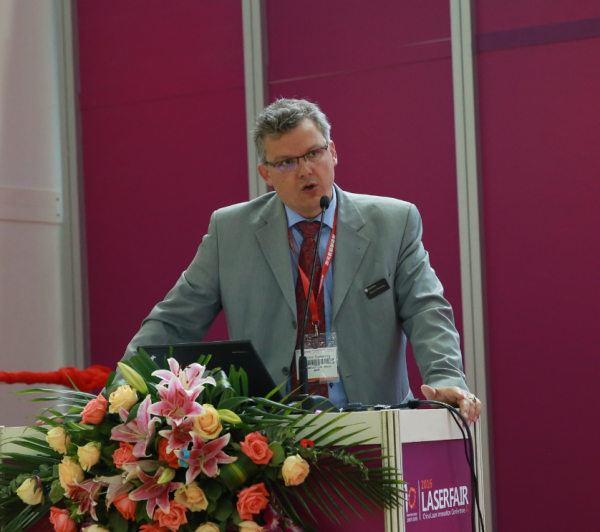
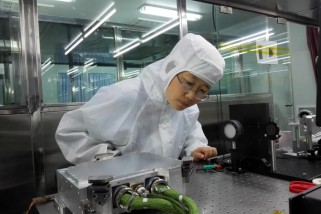
Markus Ruetering, Asia sales manager of Laserline
Laserline的亞(ya) 洲銷售經理Markus Ruetering
Laser Manufacture News: Laserline is a professional leading diode lasers supplier, so what products should we focus on in this year?
《激光製造商情》:Laserline是一家專(zhuan) 業(ye) 領先的半導體(ti) 激光器供應商,我們(men) 今年應該關(guan) 注的產(chan) 品有哪些?
Markus: As a leading company in diode lasers, we keep developing our updated developments, so we are now manufacturing our diode lasers of its sixth generation already. We’ve already introduced our sixth generation of diode lasers to the world, which are suitable for several applications, with laser power levels in the range from 1 kW up to 25 kW. We also develop our own processing optics, where we can coverapplications like brazing, hardening, heat treatment, cladding, and plastic welding as well as newer applications like additive manufacturing or tape laying of CFRP’s. Our highlight of this year is a diode laser having a blue radiation of 450 nm. And we give it a high expectation.
Markus:作為(wei) 一家領先的半導體(ti) 激光企業(ye) ,我們(men) 持續發展我們(men) 最新的發展成果,這就是為(wei) 什麽(me) 我們(men) 已經在生產(chan) 我們(men) 的第六代半導體(ti) 激光器了。我們(men) 已經推出了我們(men) 的第六代半導體(ti) 激光器,它適合用於(yu) 幾種應用,功率在1kW到25kW之間。我們(men) 還開發了自己的光學加工鏡頭,我們(men) 可以覆蓋釺焊、淬火、熱處理、熔覆和塑料焊接等應用,以及增材製造或CFRP的層鋪設等新應用。我們(men) 今年的亮點是一款有450nm藍光的半導體(ti) 激光器,我們(men) 對它抱有很高的期望。
Laser Manufacture News: What are the advantages of the blue lasers?
《激光製造商情》:藍光激光器有什麽(me) 優(you) 點?
Markus: The blue lasers with a wavelength of 450 nm have a very high absorption into materials which have a high reflection for classical wavelengths emitted by industrial lasers, so called non-ferrous metals. Specifically for copper, gold as well as silver materials.It has slightly better absorption into aluminum, but our focus with blue lasers is mainly on copper materials, as well as gold and silver. So when we look into the application that is considered from companies in terms of batteries, electronics, and the so called e-mobility – electro mobility. We need to do a lot of copper application in terms of welding, and it’s found and reported in a lot of investigations that lasers in the infrared section, infrared wavelength, cannot weld copper materials with the reason of process window or sometimes not at all. Welding copper with a 1 µm laser in addition to creating a lot of spatter, so if you have done an application, for example, in the battery industry, you have to clean the part after the welding. If you do this welds with a blue laser, the absorption is so high that you need much less power. We can do a lot of applications already with 500W using blue lasers while we need several kilowatt for infrared laser. We have a heat conduction welding rather than a keyhole welding, and the heat conduction welding helps us to have spatter-free welding of the samples, and with this, have next to the lower power, higher efficiency, and also the advantage of having a clean production.
Markus:那些對常見波長的工業(ye) 激光反射率高的材料,對波長為(wei) 450nm的藍色激光的吸收率非常高,也就是所謂的“有色金屬”,尤其是金、銀和銅。鋁材料對藍色激光的吸收率還要略微高一些,但是我們(men) 藍色激光的重點還是放在金、銀、銅上。因此,當我們(men) 研究從(cong) 電池、電子和電動汽車方麵的公司考慮的應用時,我們(men) 需要在焊接方麵進行大量的銅應用,並且在許多研究中發現並報告了紅外波段中的激光器、紅外波長由於(yu) 工藝窗口不能焊接銅材料,或者有時根本能不焊接。使用1μm激光焊接銅會(hui) 產(chan) 生大量飛濺,因此,例如在電池行業(ye) 中,您必須在完成焊接應用後清潔零件。但如果你用藍色激光進行焊接,吸收率很高,因此你需要的功率就更少。我們(men) 可以使用藍色激光器進行500W的許多應用,而相同的應用我們(men) 則需要幾千瓦的紅外激光器功率。我們(men) 有導熱焊接而不是深熔焊,熱傳(chuan) 導焊有助於(yu) 減少焊接飛濺,並且與(yu) 此相比,具有更低的功率、並保證生產(chan) 清潔高效。
Laser Manufacture News: In 2017, laser with new wavelengths attracted the attention in the market, and Laserline’s counterpart is blue diode laser, so what’s the difference between them?
《激光製造商情》:2017年時,具有新波長的激光器在市場上吸引了許多關(guan) 注,而Laserline相應的產(chan) 品就是藍光半導體(ti) 激光器,那麽(me) 它們(men) 之間有什麽(me) 不同點呢?
Markus: The general advantage of diode lasers compared to either fiber lasers or disc lasers is that we have a direct conversion from electricity to light, so we don’t have the additional converting crystals or fibers like disc and fibers, and the system in the overall efficiency of the system is higher. When we look at the application of, like say, copper, people are actually using, as well, green lasers into this field, but to create a green laser, you have to first create an infrared light, and then you have to transfer infrared into green, and this is a high loss of efficiency. It increases the cost a lot, and investigations of the application have shown that a green laser is not capable of the same applications like blue, so the blue lasers that we are offering has no converter, or any frequency doubling crystal, etc, inside the system. We are making blue light straight from the diode, which is the highest efficiency possible in such a setup, and the blue light is having such high absorption as I mentioned before that in overall process when welding copper can easily gain an advantage of a factor of 20 and higher compared to existing technologies.
Markus: 相比光纖激光器或碟片激光器,通常半導體(ti) 激光器的優(you) 勢在於(yu) 其直接的電光轉換,因此半導體(ti) 激光器不像光纖或碟片激光器需要額外的光光轉換過程,而且總體(ti) 上係統效率更高。在一些應用中,比如說銅,人們(men) 也會(hui) 用綠激光來進行銅加工,但是要產(chan) 生綠激光的前提是先生成紅外激光,然後才能把紅外光轉化為(wei) 綠激光,並且這樣會(hui) 降低能量轉換效率。這樣不但成本會(hui) 提升,而且一些應用研究顯示了綠激光並不能進行跟藍激光相同的應用。我們(men) 提供的藍激光器係統裏沒有轉換器,或倍頻水晶之類的東(dong) 西。我們(men) 直接用二極管生成藍色激光,在這樣的激光裝置中可能達到的能量效率已經是最高,而且藍色激光有如此高的吸收率,正如我前麵提到的,當焊接銅時能輕易地得到20倍或更高的吸收率,這是現有的其他技術都做不到的優(you) 勢。
Laser Manufacture News: Could you please introduce the project achievement of your blue laser? Is Laserline in a leading position in terms of blue lasers now?
《激光製造商情》:你能否介紹一下你們(men) 藍色激光的項目成果?目前Laserline在藍色激光領域是處於(yu) 領先地位嗎?
Markus: Laserline is two years through a three-year German government-funded project developing high-power blue diode lasers. The goal is to build a kilowatt blue diode laser. This was developed within the EFFILAS support measure of the Federal Ministry for Education and Research (BMBF) in close collaboration with OSRAM and other project partners, which has allowed for more effective welding processes of nonferrous metals, especially copper.Yes we have the highest power today, but we could not have done it on our own, as I mentioned it’s a funded project from the German government. The power we actually have in our laboratory is 700W, and that is, as far as we know, a world record in terms of available power in blue. We have done a lot of trails in our application lab already using 100/500/600W today with very good results. We have not released the laser as a product, because we first want to run through the project with our partners. Afterwards, I’m pretty sure that the blue diode laser will be the better technology compared to any frequency doubling or tripling that we have seen from other systems. There is another solution which is considered for blue diode laser, and I don’t think blue fiber laser or any other system has real chance to break into this market.
Markus: Laserline參加一個(ge) 為(wei) 期三年的德國政府資助的項目已經兩(liang) 年了,致力於(yu) 研發高功率藍光半導體(ti) 激光器,目標是製造出千瓦級藍光半導體(ti) 激光器。這是在OSRAM和其他項目合作夥(huo) 伴的密切合作下,在聯邦教育研究部的EFFILAS支持措施中指定的,這使得有色金屬,特別是銅的焊接工藝更加高效。沒錯,我們(men) 擁有目前最高的功率,但這不是憑我們(men) 一己之力完成的,正如我前麵提到的,這是一個(ge) 德國政府資助的項目。事實上我們(men) 擁有的實驗室功率是700W,這是據我們(men) 所知目前世界上最高功率的藍色激光。我們(men) 已經用100/500/600W的藍色激光在我們(men) 的應用實驗室中的許多試驗得到了很好的結果。我們(men) 還沒有把這個(ge) 激光器作為(wei) 產(chan) 品發布出來,因為(wei) 我們(men) 首先想要跟我們(men) 的合作夥(huo) 伴進行一些項目。最後,我非常確信藍光半導體(ti) 激光器是一種比其他係統中看到的任何倍頻或三倍頻更出色的技術。還有另一種解決(jue) 方案被考慮用於(yu) 藍光半導體(ti) 激光器,我認為(wei) 藍光光纖激光器或者任何其他係統沒有真正的機會(hui) 進入這個(ge) 市場。
轉載請注明出處。

 相關文章
相關文章
 熱門資訊
熱門資訊
 精彩導讀
精彩導讀















 關注我們
關注我們

